
CONGRATULATIONS! You are on your way to a healthier YOU!
Our program is for older adults who are choosing to move more for a healthier heart.
Beyond the ordinary
This program is for the mature adult ready to invest in a heart enlightening path to better cardiac health.
TRUST THE PROCESS

The Investment
Are you ready to be the BEST version of you?

The Planned Work
Learn about cardiovascular disease and how to slow it down or prevent it!

The Results
Improved heart health and overall fitness through our walking program!
Meet our Planning Committee
Our dedicated team of Cardiac Care professionals each bring their unique expertise and enthusiasm to our valued family.

Sharon Stevens
Program Creator

Linda Surrey
Community Engagement Coordinator/Sarcoidosis Warrior

Benjamin Orlando
Ward 10 Common Council Member

Oliver Franklin
Influencer/Digital Creator/Dietician
Meet our Planning Committee

Amee Lee
Associate of the Capital Region Chamber - American Heart Association

Charlise Yates
Retired Registered Nurse

Dr. Marc Ford
PA- OrthoNY

Jessie Zimmerman
Physical Therapist
NEEDS ASSESSMENT
PRECEDE-PROCEED Model
Social Assessment (Phase 1)
Older adults who have a sedentary lifestyle experience many significant qualities of life issues such as obesity, which can lead to cardiovascular disease and chronic kidney disease or diabetes mellitus. Musculoskeletal movement can be impeded and limited. Bone density can suffer along with back, hip, and knee joints becoming stiff and difficult to move. An older adult may have a higher risk of falling due to unsteadiness of core muscles not being utilized and not choose to ambulate within their own home or navigate steps. Activities of daily living, such as bathing, dressing, cooking, oral hygiene, and toileting may become more challenging to complete. Having less face-to-face social interactions may also lead to depression and reduced self-esteem.
Epidemiological Assessment (Phase 2)
The top three health concerns facing older adults with sedentary lifestyles are:
- Cardiovascular Disease – “The incidence of CVD was reported to be 77.2% in males and 78.2% in females, from ages 60-79 years”. Incidence of CVD was reported to be 89.3% in males, and 91.8% in females, in adults above 80 years of age”.
- Chronic pain – “The estimated prevalence of chronic pain is higher as 25-50% in community-dwelling elders, reaching up to 80% in institutionalized individuals”.
3. Muscle weakness – “As we age, our muscle-building hormones gradually decrease, and our ability to use proteins to build muscle decreases.” “Most adult-especially those who don’t exercise regularly- can lose 3% to 5% of total muscle mass every decade.” “Older adults who lose muscle also risk other potentially fatal disease conditions”.
Educational and Ecological Assessment (Phase 3)
Factors that influence behavior change or impact the environment are:
Predisposing factors – Being undereducated on how inactivity affects the body. Being born with medical issues that limit movement. How a person’s general outlook on life, if they are positive thinking and self-reliant or dismal and dependent. Cultural beliefs can also be influential on how resilient someone is. Someone who has formed a habit (i.e. smoking) is made aware they are at high risk of lung cancer. smoked for decades is told by the doctor that they are at a high risk of lung cancer. The person decides to quit cold turkey.
Enabling factors – Others who perform tasks that you can do for yourself. Using a dishwasher instead of washing dishes. People who have others discourage rather than encourage them.
Lack of movement may be due to a stairwell not being adequately lit or a distance from a high traffic area. There may not be a handrail to hold onto or non-skid pads on the steps. Neighborhood streets may lack sidewalks or level pavement. A home may not have an accessible bathroom or adaptive equipment to assist with reaching or bathing, to independently complete personal care needs. Being more reliant on use of a wheelchair instead of a walker or cane to strengthen your core and bones
Reinforcing factors – Belonging to a heart healthy support group, wellness center, senior citizen group, or other organization which focuses on health and wellness management. Volunteering with a community organization that offers education or events on cardiovascular disease. Engaging in community walks, running, or blood drives. Hosting meet-ups with special speakers sharing their own experiences and how they were able to modify their behavior.

OUR MISSION, GOALS, AND OBJECTIVES
Our Mission - Walking away from cardiovascular disease with a heart to choose to move forward.
Our Objectives for movement - Engage in 3 sets of 10 sit-to-stand exercises during a 60-minute period of prolonged sitting, each day. Engage in an outdoor walk at a moderate pace, for up to 30 minutes, daily. Engage in alternating seated marches while watching morning and/or evening television during commercials; 2 sets of 20 each.
Our Mission - Create a healthy and sustainable nutrition plan.
Our Objectives for nutrition - Limit processed foods to three meals a week. Forgo sugary snacks and drinks after 6pm., 5 days a week. Drink half of your weight in water, daily
Our Intervention Program
Health Belief Model: Perceived Susceptibility, Perceived Severity, Perceived Benefits, Cues to Action, and Self-Efficacy.
Intervention Strategies:
1. Education - Lunch time workshops; Zoom Seminars
2. Behavioral Modification - Goal Setting; Self-Monitoring
3. Environmental Change - Alarm induced movement, low-salt food/drink options, access to loaner exercise equipment, or pre-paid bus passes to a local wellness center or community gym.
4. Community Engagement - Peer Monitoring. Participation in a walking group
Objective #1: By the end of a twelve-week period, 24 previously sedentary older adults will be actively engaged in a moderate cardiovascular exercise program.
Activity: Responsible Person - Program Creator
Heart 2 Heart Lesson (READY!): Education on what a cardiovascular system consists of, understanding blood pressure and pulse readings, learning causes of hypertension and the early signs of advanced heart disease. (Implement June 2026)
Activity: Responsible Persons - Program Creator and Physical Therapy staff
Prep For Success (SET!): Modality usage, learning how to breathe during movement, Pre/post stretching techniques, and Healthy hydration options. (Implement July 2026)
Activity: Responsible Persons - Program Creator/Walking Coach
Your Race, Your Pace (GO!): Introduction to Interval Walking. How to determine which footwear is best for you. Foot placement and walking techniques. Discussion on treadmill versus pavement surface. (Implement August 2026)
Activity: Responsible Persons - Program Creator and Community Stakeholders
Each One, Teach One: Join our weekly community guest speakers as they spread the word about the importance of cardiac care. Upcoming community events and activities will be shared along with opportunities for our program participants to volunteer. There will be a name draw at the close of each class for one winner to receive a "gift of gratitude". You must be present to win and have attended all previously held sessions. (Implement August 2026)
Objective #2: By the end of a twelve-week period, 24 (or more) of previously sedentary older adults will demonstrate improved low sodium food and drink choices, 2 meals a day, 5 days a week.
Activity: Responsible Person - Program Dietician
Heart(y) & Healthy Meal Choices Lesson: Sodium will be defined with participants learning how it can negatively affect the body if not used moderately. A listing of low, moderate, and high salted foods/drinks will be distributed. (Implement September 2026)
Activity: Responsible Person - Program Creator
Food Journaling: Program participants will learn how to maintain a food log (journal). Apps such as the Sodium Tracker and My Salt Log will be discussed. (Implement October 2026)
Activity: Responsible Person - Program Creator
Peer Mentoring: This final section will form partnerships with past successful participants. Weekly in-person check-ins will be established. Telephone or other media may be used if participants have difficulty meeting in-person due to extenuating circumstances. (Implement November 2026)
Our Program
Part 1: Resource Identification
Personnel:
Health Educator Intern - Provides an overview of the program, background information on cardiac health and issues that can arise from being sedentary. Assists therapy staff with the twelve-week training sessions.
Physical Therapist Intern - Gives training on proper stretching techniques, breathing exercises, hydration options, and exercise watches with app use. Will be a guest speaker on the topic of sedentary behavior and cardiac care.
Walking Coach - Will provide an overview on interval walking, how to choose appropriate footwear foe exercise, teach walking technique and foot placement to guard against injury. Will be a guest speaker on the topic of sedentary behavior and cardiac care.
Dietician Intern - Will give an overview on Sodium and how it can benefit and negatively affect the body. Will review foods and drinks that are preferred and recommended. Will guest speak on the topic of sedentary behavior and cardiac care.
Pulmonary Registered Nurse - Will offer an overview on cardiac care and hypertension. Will give training on blood pressure cuff usage and how to interpret readings. Will be a guest speaker on the topic of sedentary behavior and cardiac care.
Curriculum and Educational Materials:
1. The Otago Exercise Program - This program was chosen for its evidenced based curriculum. It has a walking program component that is progressive in format.
2. Cardiovascular Health informational handouts from the American Heart Association - These pamphlets contain pertinent preventative information from a reputable resource.
Space Requirements: Local public library's community room. There is no cost.
A self-adjusting temperature-controlled classroom.
Six tables seating four chairs at each.
The room should have high speed internet capability with outlets.
A bathroom should be adjacent to the classroom for convenient personal hygiene needs.
Equipment and Supplies:
12 Blood Pressure kits - Provided free through the "Libraries with Heart" Program and in partnership with the local Amercian Heart Association.
White Board with rainbow pack of dry erase markers - Provided by library
Projector and Screen - Provided by library
Audio-Visual Equipment - Provided by library
24 Exercise Watches - Will pursue health insurance incentives or promotions targeting low-income seniors. Will also look at Medicare offerings for program participants.
Alcohol Wipes - Provided by program creator
Clock with a second hand - Provided by library
Purell 2-liter pump bottle hand sanitizer - Provided by program organizer
Funding Strategy:
I plan to finance my program through sponsorships with the local American Heart Association and private donors. This funding method is the most appropriate for my program because it focuses on promoting education of the senior citizen general public on cardiovascular disease, of which they are at high risk of.
Part 2: Budget Development:
Budget Summary
Revenue and Support
Source of Revenue Amount ($)
Contributions from sponsors - Blood Pressure kits $9.99 value each = $119.88. Exercise Watch $99.75 value each = $2394.
Gifts - $0 (Donated)
Participant Fees - $0 (Grant covered)
Curriculum Materials
Hand Sanitizer - $34.90
100 count - Sterile Alcohol Prep Pads $3.99
Total Income $2432.89
Expenditures - $38.89
Direct Costs - $38.89
Expense Category Amount
Personnel - Salaries & Wages $0 (All personnel are volunteering)
Fringe Benefits $0
Consultants $0
Supplies $0
Instructional Materials $0
Incentives $0
Meeting Costs $0
Equipment $0
Travel $0
Postage $15.60 (book of 20 stamps)
Advertising $0
Total Direct Costs $15.60
Indirect Costs:
Expense Category Amount ($)
Indirect Costs $0
Total Indirect Costs $0
Total Expenditures: $38.89
Balance (Total Income - Total Expenditures): $54.49
Marketing
We are offering older adults a grant offered opportunity to improve their heart health. This is an awesome way to save on future potential health costs and maintain independence. No cost (FREE). The prpogram will be held at the main branch of the public library from 11am-12 noon. Another session will be held at the local rehabilitation wellness center at 2pm-3pm. A representative from the Planning Committee will be available for brief consultations after the sessions.
Promotion: Flyers will be placed at the rehabilitation center and at all public librarys' front entrances, at the wellness center front check in desk, senior housing area. Email notifications will be sent out to area houses of worship.
*** PLEASE, ONLY SENIOR CITIZENS (AGED 60+) WHO HAVE NEVER RECEIVED REHAB SERVICES, NEED APPLY***
Our Evaluation
Pilot Study Approach
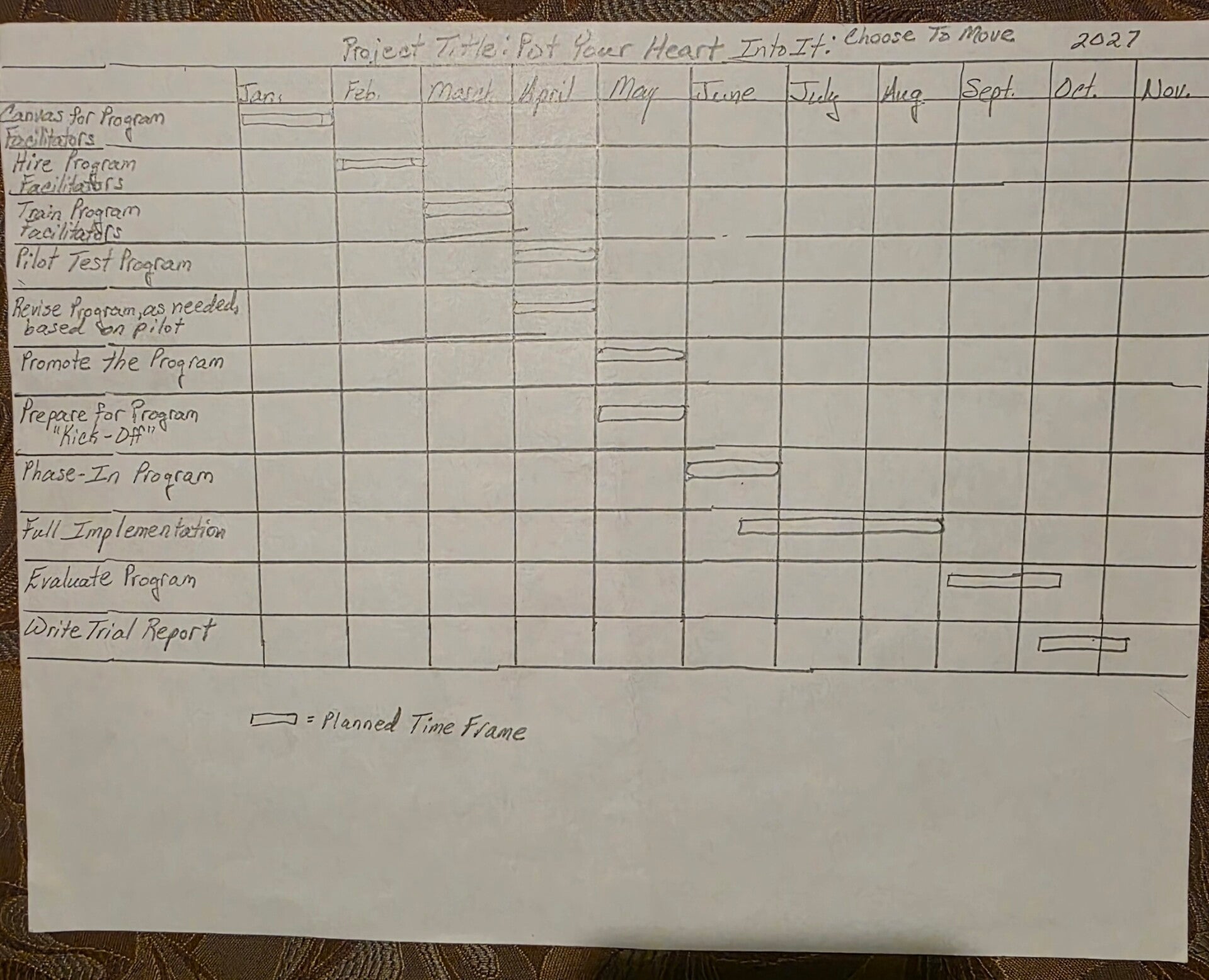
The purpose of this pilot study is to perform a mock implementation of the "Put Your Heart Into It: Choose to Move Program", which focuses on sedentary older adults moving more. The program will initially take place in a classroom setting. Once training is completed, the walking program will begin, outside at a local mall.
Steps involved in the pilot implementation:
Fidelity: Ensuring the program is being carried out as it was created on paper and that the intervention strategies are successful. This will be done beginning with education on cardiovascular disease and what constitutes an abnormal elevated blood pressure, training on how to use a blood pressure cuff, and then working on a walking program.
Adequate resources were available to carry out the program - This would include the budget expenditures that encompass the personnel needed to staff the program, payments given to the staff, postage, all contributions from sponsors, donated gifts, and curriculum materials. Also included, would be any fees for the classroom usage.
All participants will be requested for their feedback on how they felt the program was received by them and ways that it could be improved. This will also include any observations made by the staff who actively participated. All aspects of the program will be assessed to identify any issues. If significant critiques are shared that cannot be revised easily, the program will be re-examined and re-structured, then undergo another piloting event to test how sustainable it is.
Timeline and Duration - The pilot program will occur over a six-week period. The formal program is scheduled to be twelve weeks.
Success will be evaluated by how the program was received by the participating older adults, the staff, and program organizers. There will be a short rating scoring from one to five that will offer generalized insight into the program. All evaluators will additionally have the opportunity to offer more detailed comments at the close of each session.
References
McKenzie, J.F., Neiger, B.L. & Thackeray, R. (2023). "Planning, Implementing, and Evaluating Health Promotion Programs: A Primer", 8th ed. http://oswego.edu/etext
Rodgers JL, Jones, J, Bolleddu, Sl, Vanthenapalli, S, Rodgers, LE, Shah, K, Karia, K, Panguluri, SK. (2019). Cardiovascular Risks Associated with Gender and Aging. J Cardiovasc Dev Dis 2019 Apr 27;6(2): 19 DOI:10.3390/jcdd6020019.
Cravello, L., Di Santo, S, Varrassi, G, Benincasa, D, Marchettini, P, de Tommaso, M, et al. (2019) Chronic Pain in the Elderly with Cognitive Decline: A Narrative Review. Pain Ther, 8:1. DOI:10.1007/s40122-019-0111- https://www.uhc.com/news-articles/healthy-living/4-ways-to-help-fight-muscle-loss
Cabo, C'; Hernandez-Beltran, V; Parraca, J, Fernandes, O., & Espada, M. (2024). Evolution of research related to how a sedentary lifestyle influences the aging process: a 4bibliometric review. Journal of Public Health. DOI: https://doi.org/10.1007/s10389-024-02327-7
McGowan LJ, Powell R, French DP. (2021) Older adults' construal of sedentary behaviour: Implications for reducing sedentary behaviour in older adult populations. J Health Psychol. 2021 Oct;26(12):2186-2199. DOI: 10.1177/13591053
Taylor, W.C., Rix, K., Gibson, A., Paxton, R.J. (2020). Sedentary behavior and health outcomes in older adults: A systematic review[J]. AIMS Medical Science, 2020, 7(1): 10-39. DOI: 10.3934/medsci.2020002
Meneguci, G, Meneguci, J, Sasaki, JE, Tribess, S, Junior, JSV (2021). Physical activity, sedentary behavior and functionality in older adults: A cross-sectional path analysis. PLoS ONE. (2021). 16(1):e0246275. DOI: https://doi.org/10.1371/journal.pone0246275
Ma, L. (2025). Physical activity, sedentary behaviour, and intrinsic capacity at older ages: get active! The Lancet Healthy Longevity. 2025 May 6(5), 100687
Maresova, P., Krejcar, O., Maskuriy, R., Bakar, NAA, Selamat, A., Truhlarova, Z., Horak, J., Joukl, M., & Vitkova, L. (2023). Challenges and opportunity in mobility among older adults - key determinant identification. BMC Geriatr. 2023 Jul 21(23), 447. DOI: 10.1186/s12877-023-04106-7
Ferrucci L, Cooper R, Shardell M, Simonsick EM, Schrack JA, Kuh D. (2016). Age-Related Change in Mobility: Perspectives from Life Course Epidemiology and Geroscience. J Gerontol A Biol Sci Med Sci. 2016 Sep;71(9):1184-94. DOI:10.1093/gerona/glw04
Taylor, D. (2014). Physical activity is medicine for older adults. Postgraduate Medical Journal, 2014 Jan 90(1059):26-32. DOI: https://doi.org/10.1136/postgradmedj-2012-131366.
Gronek, J., Boraczynski, M, Gronak, P, Wielinski, D, Tarnas, J, Marszalek, S, Tang, YY. (2021). Exercise in Aging: Be Balanced. Aging Dis., 2021 Aug 1; 12(5): 1140-1149. DOI: 10.14336/AD.2021.0107
Wheeler, MJ, Dunstan, DW, Smith, B, Smith, KJ, Scheer, A, Lewis, J, Naylor, LH, Heinonen, I, Ellis, KA Cerin, E, Ainslie, PN, & Green, DJ. (2019). Morning exercise mitigates the impact of prolonged sitting on cerebral blood flow in older adults, Journal of Applied Physiology, 2019; 126(4): 1049-1055. DOI: https://doi.org/10.1152/japplphysiol.00001.20